
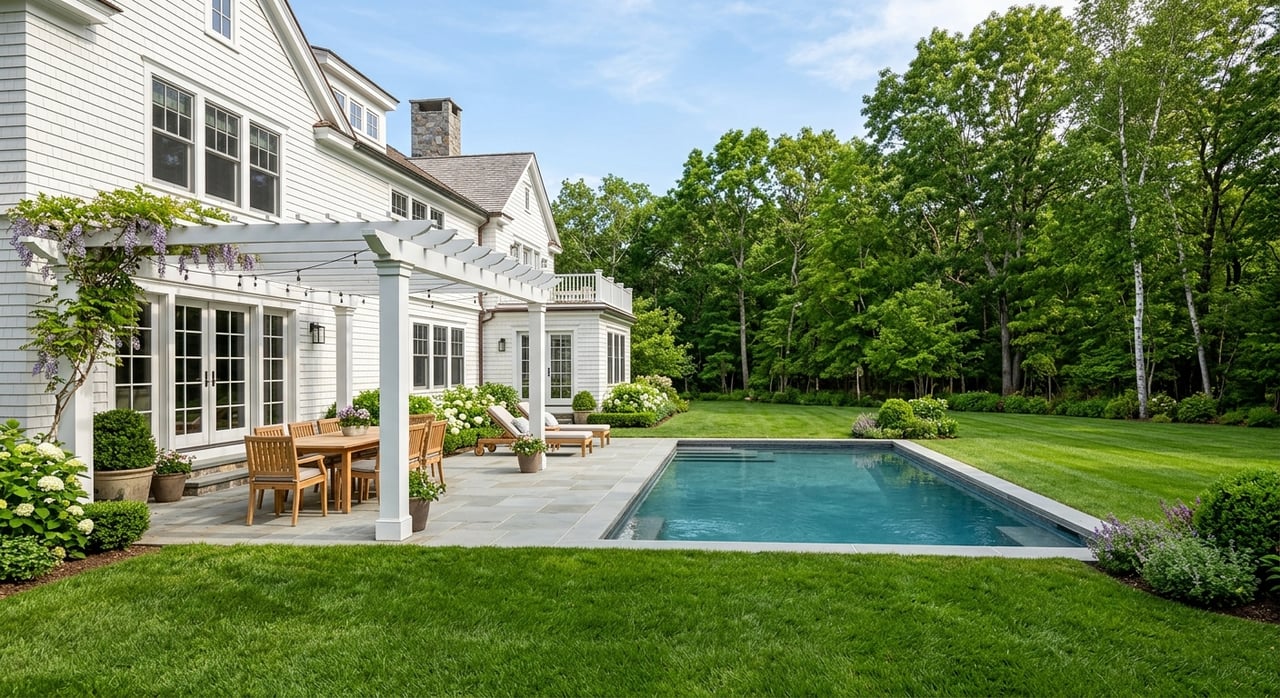
What does everyday life look like when outdoor space is not an occasional bonus, but part of how your whole week flows? In Weston, CT, that question matters because space, privacy, and access to nature shape much of the day-to-day experience. If you are considering a move to 06883 or simply want to understand how Weston feels beyond the listing photos, this guide will walk you through the town’s outdoor rhythm, practical routines, and lifestyle tradeoffs. Let’s dive in.
Outdoor space shapes Weston life
Weston has built its identity around land, privacy, and preservation. The town describes itself as a residential community in southwestern Connecticut with two-acre property zoning, minimal commercial development, and abundant natural open spaces.
That pattern affects more than curb appeal. It creates a setting where larger lots, quieter roads, and a lower-density layout are part of daily life, not just a marketing phrase. Town planning materials say roughly 29% of Weston’s land is open space, which helps explain why the town feels especially green and spacious.
Weston’s history also supports that character. The town notes that artists, writers, summer residents from New York City, and later automobile commuters helped shape its modern identity. Even today, that mix still reads clearly in the lifestyle: peaceful, residential, and connected to the wider region.
Parks and preserves support active routines
Outdoor life in Weston is not limited to private backyards. The town’s parks, preserves, and shared recreational spaces give you many ways to spend time outside during a normal week.
Weston Parks & Recreation maintains Bisceglie-Scribner Park, Morehouse Farm Park, the Middle School Pool, municipal tennis courts, and new pickleball courts at Bisceglie-Scribner Park. The department also offers summer camps, after-school classes, and sports programming, which means outdoor living here often includes organized activities as well as casual time outside.
If you enjoy walking, hiking, or spending time in preserved natural areas, Weston offers strong options close to home. The town highlights Devil’s Den Preserve, Aspetuck Land Trust properties, a 36-acre town-owned dog park, and Lachat Town Farm as part of its parks and nature network.
That variety matters because it supports different kinds of routines. One day might include a dog walk or trail outing. Another might revolve around youth sports, a seasonal program, or time spent at a farm-based community event.
Devil’s Den adds real trail access
Devil’s Den Preserve stands out as a major outdoor resource. The town describes it as The Nature Conservancy’s largest continuous preserve in Connecticut and the largest tract of protected land in densely developed Fairfield County.
For you, that means Weston offers more than small pocket parks or scattered green strips. It gives you access to a large preserved landscape that supports hiking, birding, and a stronger sense of separation from busier nearby corridors.
Lachat Town Farm brings community outdoors
Lachat Town Farm adds another layer to Weston’s lifestyle. The town describes it as a community effort connected to agriculture, sustainability, nutrition, and the arts.
That gives outdoor space a social role, not just a scenic one. It is part of what makes Weston feel community-oriented in a quieter, more grounded way than towns centered on large retail districts or entertainment zones.
Daily errands stay close to the center
One of Weston’s more distinctive lifestyle features is how much daily life clusters around a compact civic core. Rather than spreading errands across a broad commercial strip, the town centers many practical stops near Town Center and the municipal campus.
Weston says Town Center is the primary commercial destination and meet-up spot, with a local food market, bank, dry cleaner, real estate office, post office, spirits shop, restaurant, and gas and service station. That mix is modest, but it covers many routine needs.
The same area also includes the four-school campus, Town Hall, library, and municipal offices within a short walk. For many residents, that helps daily life feel more concentrated and manageable, especially compared with more spread-out suburban patterns.
A walkable civic hub matters
Weston is also investing in pedestrian connections around Town Center. According to the town, several projects are intended to improve traffic flow, increase pedestrian safety, and promote walking in and around the center, including about 5,500 linear feet of new sidewalk added through the Community Connectivity Sidewalk Project.
That does not make Weston an urban, sidewalk-everywhere town. It does show a practical effort to make movement between schools, local destinations, and civic buildings easier and safer.
Community life is quiet, but active
Because Weston is low-density and lightly commercial, some buyers assume daily life may feel isolated. In practice, the town’s civic calendar and volunteer culture suggest something more balanced.
Weston’s community calendar includes events such as Town Hall Talks, a historical exhibit opening, Colonial Trades Day & Revolutionary War Encampment, Music on the Green, and caregiver support programming. The town also emphasizes local volunteerism as part of community life.
That combination can shape your experience in a meaningful way. Weston often feels geographically quiet, yet socially engaged, with regular opportunities to participate in town life without the pace or intensity of a larger commercial center.
The tradeoff is commute versus space
For many buyers considering Weston, the central lifestyle question is simple: how much do you value land, privacy, and outdoor access compared with day-to-day commute convenience?
The data suggests that many Weston residents are comfortable making that trade. Census QuickFacts show a mean travel time to work of 46.6 minutes, an owner-occupied housing rate of 96.9%, and a median value of owner-occupied homes of $996,700.
Those numbers point to a settled ownership community where many households choose longer travel times in exchange for more room and a quieter home base. If your priorities include property size and a lower-density setting, Weston’s pattern is likely to make sense.
Weston is connected, but car-oriented
Weston’s 2020 planning survey found that 72.2% of working respondents commuted by car and 24.2% used the train. Among those commuting outside the home, the largest share went to New York City, followed by Westport.
That tells you something important about the town’s rhythm. Weston is regionally connected, but it is not built as a transit-first environment. Official directions also show access via the Merritt Parkway, I-95, and US-7, reinforcing the fact that driving is a central part of daily mobility here.
In other words, Weston often works best for buyers who want a peaceful residential setting and are comfortable planning around car travel. The reward is a home environment that feels more removed and spacious than many neighboring options.
What a weekday in Weston can feel like
If you are trying to picture actual daily life, think less about nonstop activity and more about steady, grounded routines. A weekday in Weston may include a short run of errands near Town Center, time on local fields or courts, a walk on preserved land, and a drive to nearby towns for additional services or appointments.
That practical regional flow is part of the lifestyle. The town’s Dial-A-Ride program for seniors and disabled residents, serving medical appointments in Westport, Norwalk, Georgetown, and Wilton, is another reminder that everyday life in Weston often extends beyond town lines even while home life stays rooted in a quieter setting.
This is one reason Weston appeals to buyers who want room to breathe without feeling cut off from lower Fairfield County. You get a residential environment shaped by preservation and open land, while still staying within reach of nearby towns and the broader metro area.
Why Weston stands out in Fairfield County
In a region where many towns balance growth, convenience, and residential demand differently, Weston stands out for its commitment to lower-density living. Two-acre zoning, limited commercial development, and a meaningful amount of protected open space give the town a distinct feel.
That feel can be especially appealing if you are searching for a home where outdoor space supports your everyday life rather than sitting on the sidelines. Whether that means a larger yard, easier access to trails and community recreation, or simply a calmer pace after a workday, Weston offers a lifestyle shaped by land in a very real way.
For buyers moving within Fairfield County or relocating from outside the area, that distinction is worth understanding early. Weston is not trying to be the busiest or most built-up option. Its value is in space, routine, and a town pattern that keeps nature close.
If you are weighing whether Weston fits your lifestyle goals, the answer often comes down to how you want your home to feel when the day begins and ends. For many buyers, that combination of privacy, outdoor access, and a compact civic center is exactly the point.
If you are exploring Weston or comparing it with other lower Fairfield County towns, Karen Cross can help you evaluate the lifestyle, property options, and local market with a clear, tailored approach.
FAQs
What is everyday outdoor life like in Weston, CT?
- Outdoor life in Weston often includes private yard space, local parks, trails, sports facilities, a town-owned dog park, and community-focused places like Lachat Town Farm.
How much open space does Weston, CT have?
- Town planning materials say roughly 29% of Weston’s land is open space, which supports the town’s spacious and preserved character.
Is Weston, CT walkable for daily errands?
- Weston is not a highly urban walkable town, but its Town Center and civic campus cluster several everyday destinations close together, and the town has added sidewalk improvements to support walking around that area.
What parks and nature areas are in Weston, CT?
- The town highlights Bisceglie-Scribner Park, Morehouse Farm Park, Devil’s Den Preserve, Lachat Town Farm, Aspetuck Land Trust spaces, municipal courts, and a 36-acre dog park.
Is Weston, CT good for commuters?
- Weston offers regional access through major roads and some train commuting, but daily life is largely car-oriented and many residents accept longer commute times in exchange for more space and privacy.
What makes Weston, CT different from other Fairfield County towns?
- Weston stands out for its two-acre zoning, minimal commercial development, significant open space, and a lifestyle centered on privacy, nature, and a compact civic core rather than a large retail district.